
What the 2026 US Midterm Elections Mean: Congress, Senate, House and Governors

On November 3, 2026, Americans vote in midterm elections that could reshape the final two years of President Donald Trump’s term. Midterms happen halfway through a four-year presidential term. The president is not on the ballot, but voters choose lawmakers and governors whose decisions affect taxes, spending, immigration, healthcare, energy and national policy. The result will help determine how easily Trump can move his agenda through Congress. [1][2]
What are midterm elections, and why do they matter?
Congress is the federal legislature and has two chambers: the House of Representatives and the Senate. Both must generally approve a bill before it can become law, and the president must sign it or Congress must override a veto. Control of either chamber matters because a party can advance its priorities, block the other party’s bills, shape committee agendas and conduct oversight.
How long does each elected position serve?
House members serve two-year terms, so all 435 voting seats are contested in every midterm. Senators serve six-year terms, with roughly one-third of the 100 seats normally up every two years; 35 Senate seats are being contested in 2026, including regular and special elections. Governors serve terms set by state law—usually four years, although some states elect governors every two years. In 2026, 36 states hold gubernatorial elections. [1][2]
Current balance of power: House and Senate
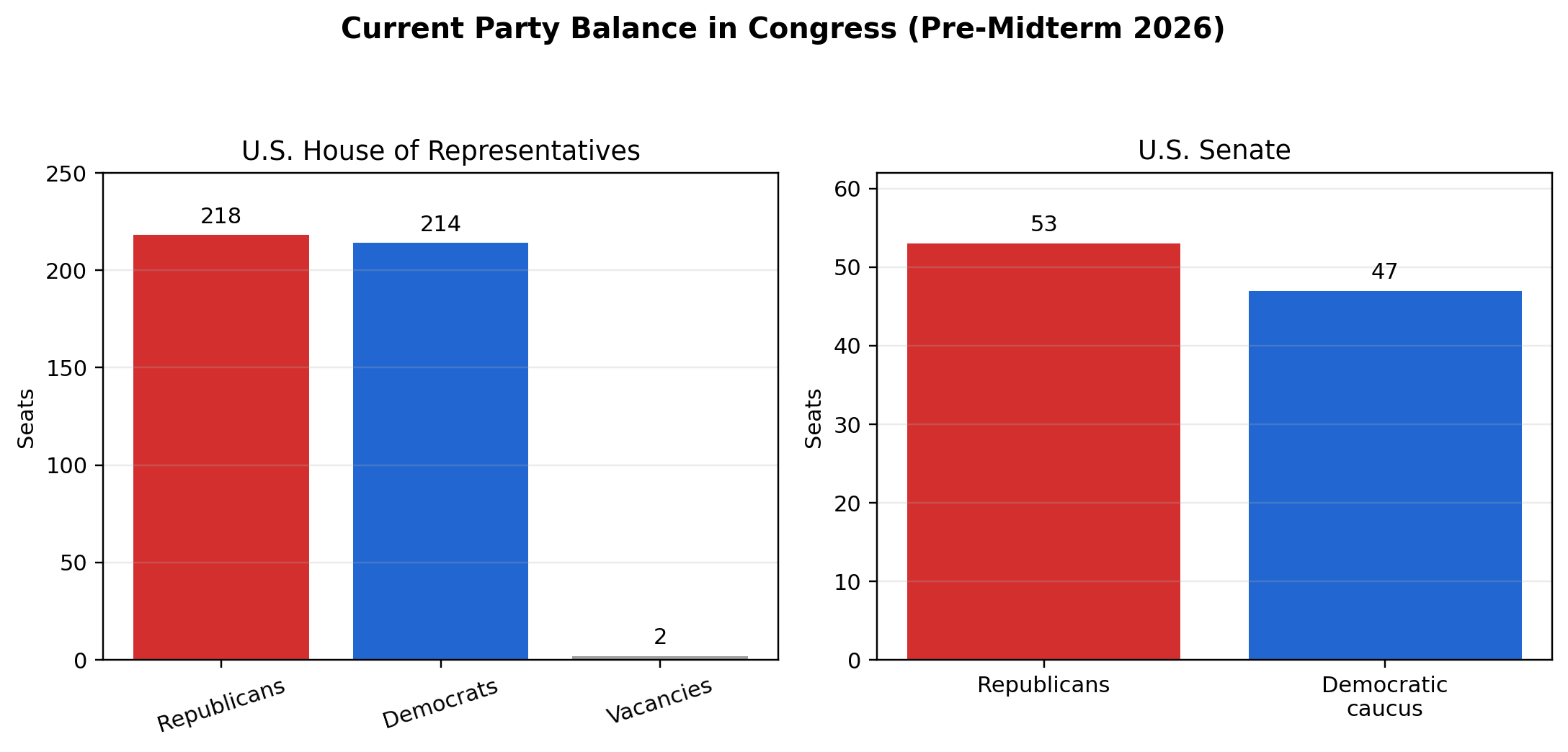
Before election day, Republicans hold a narrow House advantage: 218 Republicans, 214 Democrats, two vacancies and one independent who caucuses with Republicans. Democrats need a net gain of four seats to win a working majority, depending on vacancies and final membership. In the Senate, Republicans hold 53 seats while the Democratic caucus has 47, including independents who usually vote with Democrats. Democrats need a net gain of four seats to reach 51 and control the chamber without relying on the vice-president’s tie-breaking vote. [1][3]
What are polls and forecasts saying?
Forecasts available on November 2 suggest Democrats are well positioned to compete for the House, while the Senate remains more uncertain because Democrats must overcome a larger seat deficit and defend vulnerable seats. Nate Silver’s FLIPR model said Democratic chances of retaking both chambers had reached new highs after late polling, but its public page did not expose precise probabilities without a subscription. CBS News highlighted 42 competitive House races and 11 key Senate races. These are forecasts, not results: polls can be wrong, turnout differs by state, and district boundaries affect how votes translate into seats. [3][4]
How many governor races are on the line?
Thirty-six of the 50 governorships are being contested in 2026. Governors influence state budgets, education, public safety, health policy, energy projects and election administration. Their results can affect how states respond to federal policy. A party can win congressional seats nationally yet lose governorships in individual states, so governor results should be tracked separately from House and Senate control. [2]
What would a Democratic win mean for President Trump?
If Democrats win the House, they could choose the speaker, control committees, set hearing agendas and use subpoena powers to investigate the administration. They could pass bills reflecting Democratic priorities, but a Republican-controlled Senate could block many of them. If Democrats also win the Senate, confirmations and legislation would become more difficult for Trump, although a two-thirds majority in both chambers would still be needed to override a presidential veto.
Could Congress remove the president?
A Democratic victory would not automatically remove Trump from office or end his executive powers. The House can impeach, but removal requires conviction by two-thirds of senators present. The president retains important powers over foreign policy and executive agencies, subject to laws, courts and other constraints. If Republicans keep both chambers, Trump would generally have a smoother path for legislation and confirmations, though narrow majorities can still be difficult to manage.
What issues may decide the vote?
Cost of living—including groceries, housing, fuel and healthcare—is central to voter concerns. Immigration, tariffs, the war involving Iran, and regulation of artificial intelligence are also shaping debate. Midterms often act as a referendum on the president, and history shows the party in the White House frequently loses congressional seats. But the outcome is not predetermined: candidate quality, local issues, turnout, campaign spending and close races can outweigh national trends. [1][2]
Conclusion: why the 2026 midterms matter
The 2026 US midterm elections will determine more than who holds seats in Washington. They will shape the balance between Congress and the White House, influence investigations and legislation, and decide which parties lead 36 state governments. The House is especially competitive, while the Senate contest is harder for Democrats because they need a larger net gain. Polls provide clues, not certainty. The final results will show whether voters want to reinforce Trump’s agenda or create a stronger check on his administration.
Sources and Further Reading
- BBC News — What are the US midterms? A simple guide — bbc.com
- Reuters — What you need to know about the 2026 US midterm elections — investing.com
- CBS News — 2026 midterm election races to watch — cbsnews.com
- Silver Bulletin — FLIPR 2026 midterm election forecast — natesilver.net
- Reuters — Six things to watch as US voters decide control of Congress — reuters.com
Related articles

European Supermarkets Hit by Suspected Cyberattacks as Freezers Overheat Across Seven Countries

Learjet 60 Crash Near Palm Beach: What We Know About the Florida Private Jet Disaster

Flávio Bolsonaro's 2026 Election Campaign, Defeat and Reported Departure to the United States

Brazil Election 2026 — Results, Key Issues, and Political Impact